
The solid wood vs MDF question comes up on almost every budget furniture listing, and the descriptions don’t always help. “Wood construction” can mean anything from a solid oak frame to pressed fiber with a printed surface. These five checks help you work out which one you’re buying.
Material facts below come from Wikipedia’s entry on medium-density fibreboard. The hands-on checks are general buying guidance.
1. Look for Grain on Every Surface
MDF is made of wood fibers pressed together with resin and wax, so it has no knots, rings or natural grain. Solid wood does. Look at the underside, the back panel and any cut edges. If every surface is perfectly uniform, or the grain repeats like a pattern, you are probably looking at MDF or a printed surface.
2. Check the Edges
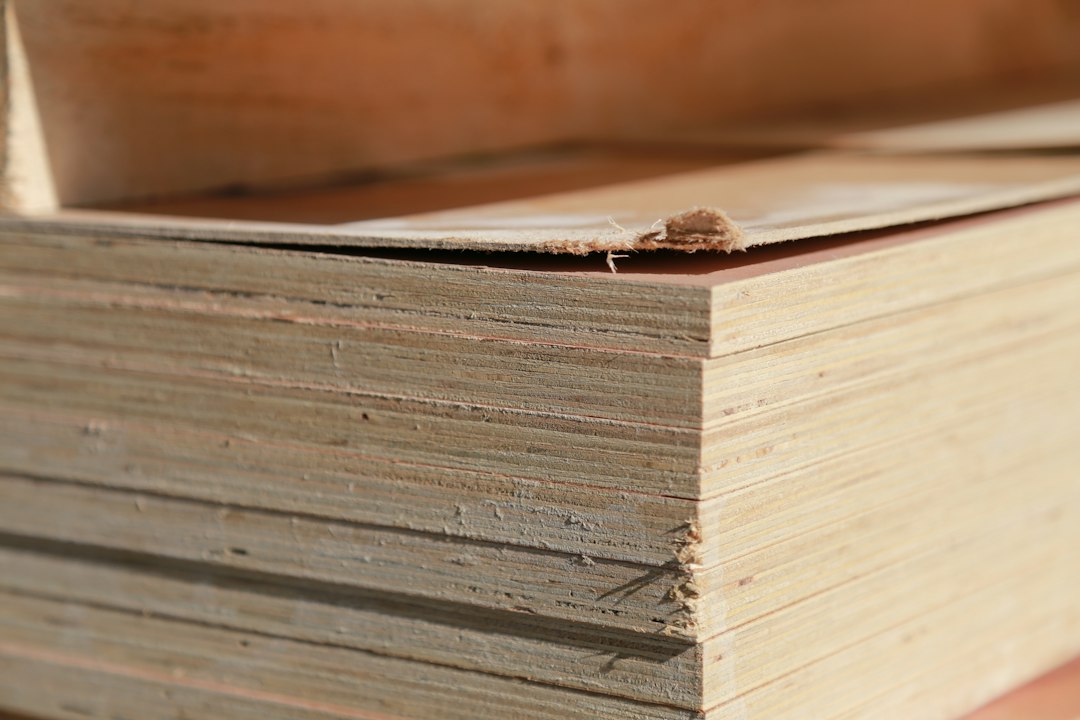
A cut edge of MDF looks like dense, smooth cardboard-colored board with no grain lines. A veneered edge may have a visible seam or a thin wrapped strip. Solid wood edges show continuous grain that matches the face. If an edge is hidden behind a strip of plastic or tape, ask what’s under it.
Photo: nate / Unsplash. Featured image: LUCIA LU / Unsplash
3. Don’t Trust Weight Alone
MDF is dense, typically 600 to 800 kg per cubic meter, so a heavy piece isn’t automatically solid wood. Weight is a weak clue on its own. It’s more useful in combination with the grain and edge checks above.
4. Look at How the Pieces Are Joined
Fine-pitch screws hold poorly in MDF, especially in the edges, and edge screws can split it without pilot holes. If legs or rails are held on only by screws driven into panel edges, that’s a weak point. Solid wood joinery such as dowels, mortise and tenon, or screws into solid timber usually holds up better to repeated assembly.
5. Think About Moisture and Air Quality
MDF has poor moisture resistance, and low-grade boards can swell and break when saturated, so it’s mainly an indoor material. It also releases formaldehyde and other volatile compounds for at least several months after manufacture, which is worth knowing for a bedroom or a small space. Ask about emissions standards or let a new piece air out in a ventilated room.
MDF Isn’t Automatically Bad
MDF is uniform and smooth, which makes it a good base for veneer and painted finishes. Used for a dry indoor piece that you aren’t going to move often, it can be a sensible way to keep a price down. Our walnut versus veneer guide covers the related question of what’s under a wood surface.
Words to Watch in a Listing
Sellers use these terms loosely, so treat them as prompts for questions rather than proof. “Solid wood” should mean the named parts are timber all the way through. “Wood veneer” means a thin layer of wood over a core, often MDF or plywood. “Engineered wood,” “manufactured wood” and “composite wood” generally point to MDF, particleboard or similar panels. “Wood finish” or “wood look” says nothing about what’s underneath.
Questions to Ask the Seller
If the listing doesn’t say, a short message usually settles it:
- Is the frame solid wood, and which species?
- Is the top solid wood, veneer or laminate, and what is the core?
- Are the legs and rails solid wood, or cut from panel?
- Does the piece meet emission standards for formaldehyde in composite wood?
- What is the return window if it isn’t what the listing described?
A seller who answers with specifics is a good sign. A vague reply about “quality wood construction” is a cue to price the piece as MDF.
Solid Wood vs MDF: The Bottom Line
Look for real grain, inspect the edges, don’t lean on weight, check the joinery, and keep MDF away from damp. The honest question isn’t which is better, it’s whether the listing tells you which one you’re getting and prices it accordingly.