
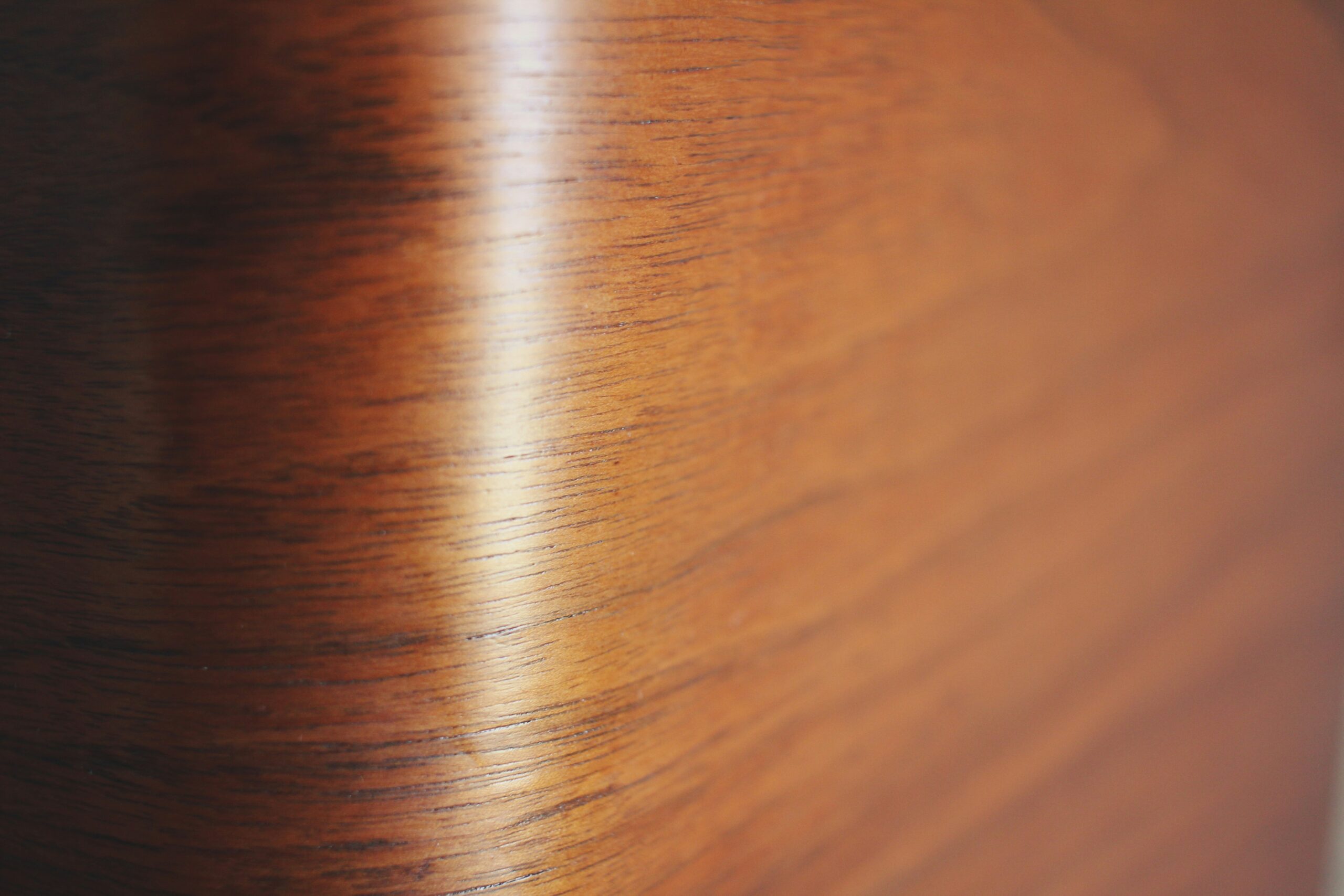
Walnut is the wood most people picture when they think “mid-century modern.” Its warm, reddish-brown tone and distinctive grain defined the era’s classic case goods, credenzas, and dining sets — and it’s still the most name-dropped material in furniture listings today. The problem with telling wood vs veneer apart: “walnut” on a product page can mean anything from a solid plank to a thin printed layer glued over particleboard, and most retailers aren’t in a hurry to clarify which.
That’s not automatically a dealbreaker — veneer has a legitimate place in good furniture, and we’ll get to that. But you should know what you’re actually buying before you pay solid-wood prices for it. Here’s how to tell the difference in five minutes with a piece in front of you, or from photos if that’s all you have.
Table of Contents
Why Wood vs Veneer Matters More for MCM Furniture
Original mid-century pieces from the 1950s and ’60s were often built with solid walnut frames and legs, with veneer reserved for large flat surfaces like tabletops and case fronts — a completely standard, respected technique even then, since a single flat sheet of solid walnut that wide would warp. The issue with a lot of today’s “MCM-inspired” furniture isn’t that it uses veneer; it’s that it uses veneer everywhere, including load-bearing legs and frames where the original pieces used solid wood, and prices it as if it hadn’t.
The 5-Point Wood vs Veneer Check
1. Check the grain at a corner
This is the fastest tell, and you can usually do it from a listing’s photos alone. On a solid piece, the wood grain continues around a corner or edge in one unbroken pattern, because it’s one continuous piece of material. On veneer, the grain on the face and the grain on the edge won’t line up — the edge is often a totally different piece of material (sometimes not even wood at all, but an edge-banding strip printed to match). Zoom into any corner or edge in a product photo and look for that mismatch.
2. Look underneath
If you can get a piece in person, flip it over or check the underside of a drawer. An unfinished or unsealed edge on veneer furniture will often reveal the layered plywood or MDF core beneath the thin wood face — you’ll see a cross-section of the material rather than solid wood all the way through. Retailers who use real solid wood tend to be proud of it and often leave undersides raw specifically so you can see this.
3. Knock lightly on the surface
Solid wood has a denser, more solid-sounding knock. Veneer over MDF or particleboard tends to sound slightly hollow or dull by comparison, especially over larger flat panels. It’s a subtle difference and takes some ear-training, but if you’ve handled both kinds of furniture before, you’ll notice it immediately.
4. Compare the weight
Solid walnut is a genuinely heavy wood. A veneer-over-MDF piece of the same dimensions will almost always be noticeably lighter, since MDF and particleboard cores weigh less than an equivalent volume of solid hardwood. If you’re comparing two similarly sized dressers or credenzas and one feels dramatically lighter than you’d expect, that’s a strong signal.
5. Ask for the wood species in writing
This is the most reliable check of all, and it costs nothing. A listing or customer service rep who says “walnut” without qualifying it is being vague on purpose. Ask directly: is this solid walnut, or walnut veneer, and over what substrate? A retailer confident in solid construction will answer immediately and specifically. Hedging, changing the subject, or repeating “walnut finish” back to you is itself the answer.

Photo: Urban Vintage / Unsplash. Featured image: Hal Gatewood / Unsplash
Veneer Isn’t Automatically the Enemy
Worth saying clearly: wood veneer construction, done well, is not a red flag by itself. It’s more dimensionally stable than solid wood on wide flat surfaces, uses less old-growth timber per piece, and lets a manufacturer showcase a dramatic grain pattern that would be prohibitively expensive in solid form. The actual Eames lounge chair shell is molded plywood with a veneer face, and nobody reasonably calls that piece cheap — though plenty of cheaper recreations get the same construction wrong in ways that are easy to spot once you know what to check on an Eames recreation.
In the wood vs veneer debate, what actually matters is whether the construction matches the price and the marketing. A veneer piece sold honestly as veneer, built with real wood veneer (not printed laminate) over a solid core, with good joinery — that’s a legitimate choice, often a smart one. The problem is only when “walnut” is used to imply solid construction that isn’t there.
Wood vs Veneer: The Bottom Line
None of these five checks require special tools or expertise — just a closer look than most shoppers bother to take. A retailer selling honest, well-made veneer furniture will hold up under all five. One padding a particleboard piece with the word “walnut” usually won’t survive the first two.
2 responses to “How to Spot Real Walnut vs. Veneer: A Buyer’s Guide”
[…] for a line that shouldn’t be there. This is the same core check we cover in more depth in spotting real walnut vs. veneer generally, applied specifically to a molded […]
[…] piece that you aren’t going to move often, it can be a sensible way to keep a price down. Our walnut versus veneer guide covers the related question of what’s under a wood […]